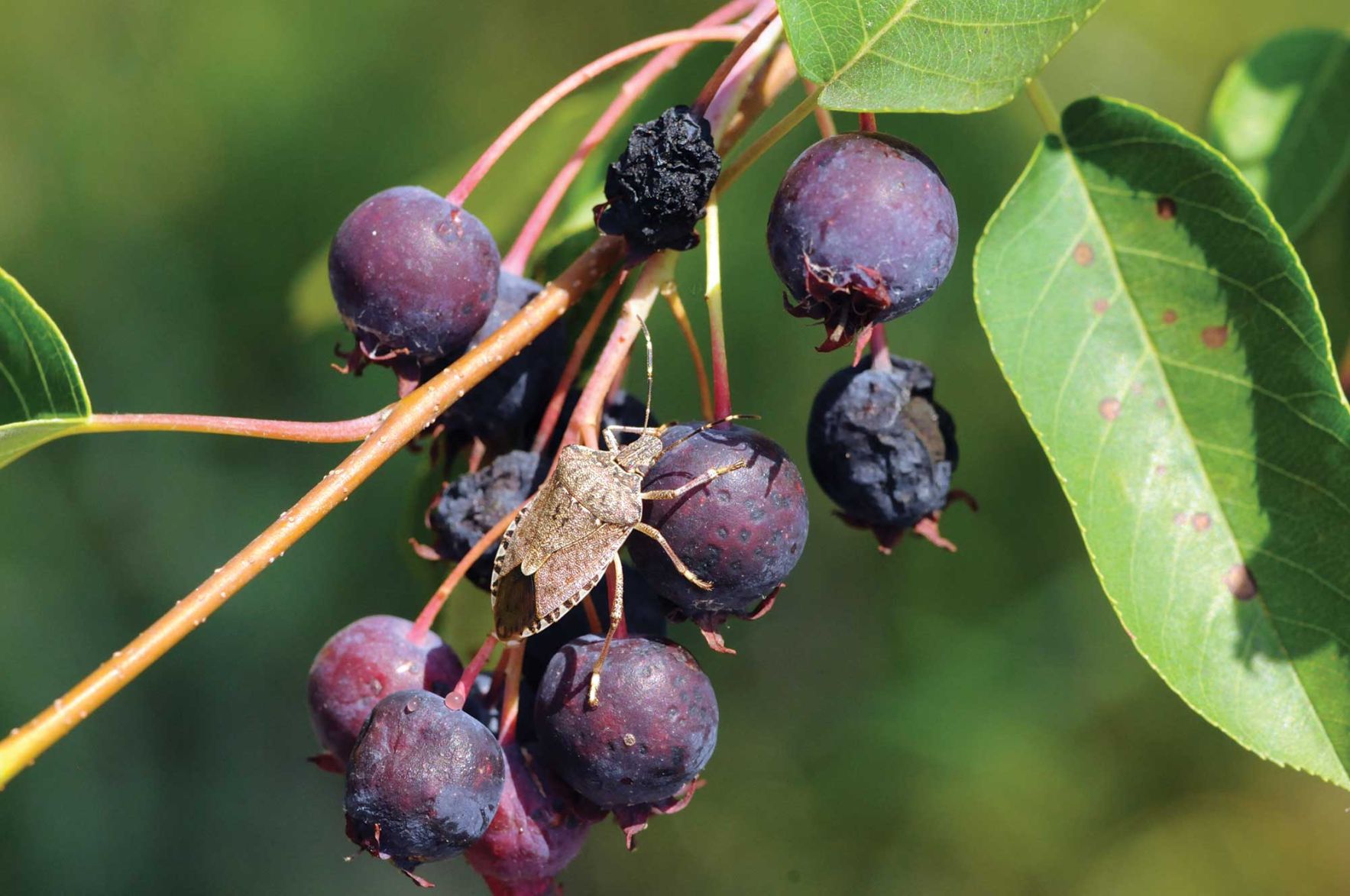

A stinkbug crawls on a bunch of blueberries. Stinkbugs are attracted to ripe fruit.
Reducing the availability of mature fruit could stifle stinkbug population growth, a new study by university researchers found.
Researchers determined the presence of ripened fruits on trees positively correlates with an abundance of the smelly home invader, according to the study, published online June 25 in the Journal of Pest Science. The research team aimed to discover what attracts stinkbugs and when the insects are drawn by it, said Holly Martinson, a university entomology research associate and the study’s lead author.
“There’s been a lot of anecdotal evidence that suggests stinkbugs are attracted to ripe fruit,” Martinson said. “But no one had ever tested it.”
The study examined the numbers of stinkbugs on nearly 4,000 fruit-bearing trees in this state over the course of three years, Martinson said. Researchers found that the trees bearing ripe fruit attracted more than twice as many stinkbugs as those with immature fruit.
“The peaks of abundance matched up exactly to when the trees were fruiting,” Martinson said.
These observations were followed by a manipulative study in which researchers completely removed the fruit from about 30 of those trees. Devoid of fruit, these trees saw a dramatic reduction in stinkbugs, said Michael Raupp, a university entomology professor and co-author of the study.
Researchers concluded that planting fruitless trees could be key in driving off the ravenous pests. Moreover, planting varieties of fruit trees that mature when stinkbugs are less numerous could also help, Raupp said.
While stinkbugs are notorious for finding their way into homes, the real damage comes to agriculture. The pests can cause extensive harm to many types of produce, including apples, berries and peaches, Martinson said.
“Stinkbugs completely rocked the East Coast upon their arrival,” Raupp said. “On top of being a home invader, stinkbugs caused tens of millions of dollars in damages to fruit crops.”
Those involved with the study said they hope knowing stinkbugs’ environmental preferences will help with pest-control efforts, Martinson said.
The authors made it clear that this research is an ongoing endeavor with further investigations planned.
“This study is one important piece of a much larger picture on how to manage this particular pest,” said Dilip Venugopal, a university entomology research associate and co-author of the study. “It is a small piece of the puzzle, but an important piece.”
This university’s team is not alone in its efforts, however, as these researchers are just some of many seeking to control the stinkbug population.
“This is a big collaborative project spanning over 17 institutions and involving over 50 researchers,” Venugopal said.
It is not far-fetched to say living in an area with low numbers of fruit-bearing trees could help one avoid stinkbugs, based on the study’s findings, Martinson said. But with more work to be done, there remains no “sure way” to ward off the nuisances — aside from weatherproofing homes.
“It’d be fun to see if plucking fruits off nearby trees can reduce the number of stinkbugs in your home,” Martinson said. “We aren’t quite there yet, but that could be something interesting to look for in the future.”