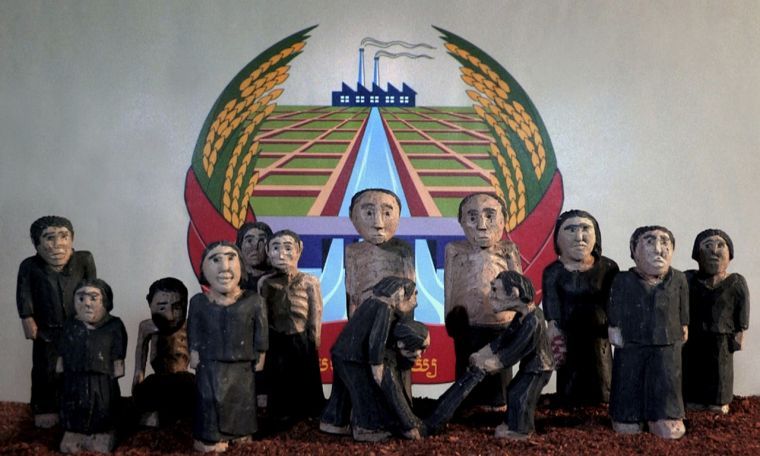

“Using clay figurines, archival footage and narration of his own memories, he seeks to create a visual record, however imperfect, of the atrocities he survived, bringing his still images to life using a Ken Burns-esque combination of camera movement and offscreen sound. The resulting film is a harrowing, devastating attempt to comprehend an evil so great it can never be fully understood.” — Robert Gifford
The genocide perpetrated by the Khmer Rouge in Cambodia was one of the worst in history, killing as many as 3 million people in a country with a population of just more than 8 million. In dictator Pol Pot’s ill-fated attempts to impose agrarian socialism on his people, forced relocation, involuntary labor, malnutrition, torture and execution led to a horrific humanitarian crisis that lingers in the national memory to this day.
The motivating question of The Missing Picture, however, is how long that memory will last. The regime’s authoritarianism applied even to art; any image not sanctioned by the state was destroyed, often along with its creator. The little footage of the infamous “Killing Fields” — a series of mass graves — that survives is all thoroughly sanitized propaganda. There are no photos of starving children or violated bodies to make the tragedy real, as there are of the Holocaust or Rwanda or any other crime against humanity. There is a blank spot in the historical record in which visual evidence of the massive crime the Khmer Rouge committed should be.
Rithy Panh (Gibier d’élevage), a survivor of the Killing Fields, seeks to correct that absence with this Oscar-nominated documentary. Using clay figurines, archival footage and narration of his own memories, he seeks to create a visual record, however imperfect, of the atrocities he survived, bringing his still images to life using a Ken Burns-esque combination of camera movement and offscreen sound. The resulting film is a harrowing, devastating attempt to comprehend an evil so great it can never be fully understood.
Less a documentary than a filmed memoir, The Missing Picture is mostly limited to Panh’s own experiences. He recalls his life before the war, his forced removal from Phnom Penh, Cambodia, to a labor camp for “re-education” and the death of his family, before he finally attempts (never quite succeeding) to find an explanation for how this could happen.
Dioramas filled with immobile clay figurines are clearly inadequate to the task of representing the mass murder of millions of civilians, but perhaps that’s part of the point — in the absence of any photographic evidence, the only methods of preserving the tragedy’s memory are necessarily inadequate.
That does not mean Panh’s quest is futile, however. He does not succeed in conjuring from thin air a perfect visual record of the Cambodian genocide, a sin too immense for any one telling, but he creates a moving and disturbing account of his own trauma. At least one man’s story will not be forgotten.
[ READ MORE: This week’s new movies: Captain America, the Khmer Rouge and the best action movie of the year ]